
THE ELECTRICAL VULNERABILITY OF HUMAN SKIN AND ITS IMPLICATIONS FOR DIVERTED NEUTRAL CURRENT EXPOSURE
By Bob Preston
Quick Navigation
The Stratum Corneum: A Variable and Fragile Electrical Barrier
The stratum corneum, long assumed to be a stable protective resistor, is in reality a highly variable and easily compromised barrier. Its resistivity spans several orders of magnitude and shifts dramatically with hydration, ionic composition, temperature, and individual physiology.
Even slight increases in moisture cause the barrier to swell, loosen, and lose its insulating structure. Sweat, humidity, and ionic fluid movement all enhance conductance, allowing electrical current to pass through the skin far more readily than traditional assumptions suggest.
This variability means the skin cannot be treated as a predictable resistor. Instead, it behaves as a dynamic, environmentally sensitive interface whose protective capacity collapses under conditions commonly encountered in domestic and occupational settings.
Real-World Contact Conditions That Collapse Skin Resistance
Mechanical Pressure and Contact Area
Pressure flattens the skin, increases the eƯective contact area, and forces moisture to the surface. This compression reduces the thickness of the stratum corneum and enhances electrical coupling between the skin and conductive surfaces.
Moisture and Hydration
Even small amounts of sweat or water dramatically alter the electrical properties of the skin. Hydration softens the barrier, increases ionic mobility, and opens pathways that allow current to penetrate deeper into the tissue.
Appendageal Shunt Pathways
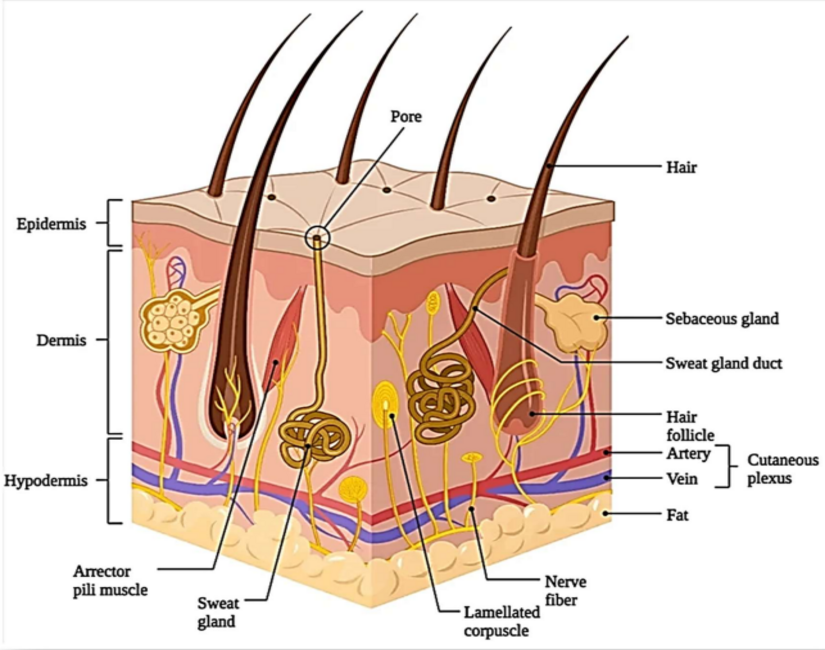
Sweat ducts, hair follicles, and other microscopic openings act as natural low-resistance channels. These structures penetrate deep into the epidermis and dermis, by passing the more resistive outer layers.
This uneven distribution is not incidental; it defines how electricity enters the body.
Anatomical Variability
Different regions of the skin contain varying densities of appendages, moisture levels, and barrier thicknesses. The body therefore presents a patchwork of high- and low-resistance zones that shift with environment, temperature, and physiological state.
Together, these factors create conditions in which the skin’s protective impedance collapses, enabling even modest voltage rises to drive significant current.
Voltage-Driven Breakdown of the Skin Barrier
When electrical potential is applied to the skin, the barrier does not remain static. Instead, it undergoes structural changes that further reduce resistance.
Electrical exposure does not simply push against a fixed, stable skin barrier.
Instead, the moment voltage is applied, the stratum corneum undergoes rapid biophysical changes that weaken its protective function. The skin’s outer layer is highly sensitive to electrical fields, moisture, pressure, and ionic movement and these influences interact in ways that dramatically reduce its resistance at the exact moment current attempts to enter the body.
This means that voltage rises on bonded metalwork, such as those produced by diverted neutral currents, do not meet a fixed or stable barrier. Instead, the applied electric field immediately disrupts the stratum corneum’s structure weakening the lipid matrix, increasing hydration and opening conductive pathways so the skin’s defences actively collapse at the moment of exposure. Becoming progressively more permeable, more hydrated and more conductive in real time.
These changes occur through three fundamental mechanisms, each of which is well-established in biophysics and directly relevant to real-world electrical contact.
Together, they explain why the skin’s impedance collapses under everyday conditions and why even modest voltages can drive meaningful current into the deeper, ionically
conductive tissues of the body.
The following sections outline these mechanisms in detail and show how they operate in
real time during electrical exposure.
Electroporation
What Electroporation Is
Electroporation is a biophysical phenomenon in which exposure to an electric field causes temporary or permanent nanopores to form in lipid membranes.
These pores increase the permeability of the membrane, allowing ions, water, and charged molecules to pass through far more easily than normal.
It occurs in all lipid-based biological membranes, including:
- the lipid bilayers of the stratum corneum
- keratinocyte membranes
- cell membranes throughout the viable epidermis and dermis
Electroporation is not a chemical reaction.
It is a structural rearrangement of lipids caused by electrical forces.
Why Electroporation Happens
Biological membranes are made of phospholipids arranged in a bilayer.
These lipids have:
- hydrophilic heads (water-loving)
- hydrophobic tails (water-repelling)
Under normal conditions, this structure forms a stable, low-permeability barrier.
When an electric field is applied:
- The membrane becomes polarized, one side becomes more positive, the other more negative.
- Electrical stress stretches the membrane, thinning it.
- Water molecules are pulled into the membrane, forming “water fingers.”
- These water fingers force open nanometre-scale pores in the lipid structure.
These pores can be:
- Transient (reversible) the membrane reseals after the field is removed
- Long-lasting (semi-reversible)
- Permanent (irreversible) if the field is strong or prolonged
The threshold for electroporation depends on:
- membrane thickness
- hydration
- temperature
- ionic composition
- duration of exposure
- local geometry (curved surfaces, appendages, micro-defects)
Electroporation in Human Skin
Human skin is uniquely susceptible to electroporation because:
- The stratum corneum is thin, dry, and lipid-rich.
- The viable epidermis contains hydrated cells with conductive cytoplasm.
- Sweat ducts and follicles create local field intensification, lowering the threshold.
This is a direct description of electroporation occurring in the skin barrier.
Even modest voltages can cause:
- lipid disordering
- increased water penetration
- pore formation
- reduced resistance
- deeper current penetration
This is why electroporation is widely used in:
- transdermal drug delivery
- gene therapy
- cosmetic treatments
- medical electroporation devices
The same mechanism applies during accidental electrical exposure.
What Electroporation Does to Electrical Conductivity
Once pores form:
- The membrane’s resistance drops sharply.
- Ions can cross the barrier freely.
- The tissue becomes more conductive.
- Current penetrates deeper into the skin layers.
- The deeper tissues (which are ionic and hydrated) conduct current very eƯiciently.
This is not theoretical; it is a well-documented biophysical effect.
Electroporation is one of the reasons why skin resistance decreases with voltage.
Electroporation and Diverted Neutral Currents (DNC)
Electroporation explains why low-voltage rises on metalwork can still produce
meaningful current flow through the body.
- Any moisture softens the stratum corneum and lowers the threshold for electroporation.
- Pressure and contact area increase local field strength.
- Appendageal structures (sweat ducts, follicles) concentrate electric fields.
- Even modest voltages can open transient pores in the barrier.
- Once pores form, the skin becomes far more conductive.
- Current then enters the viable epidermis and dermis, which are naturally ionic conductors.
- The body becomes highly susceptible to current flow.
This is the direct, experimentally observed behaviour of human skin under electrical stress.
Electro-osmosis
What Electro-Osmosis Is
Electro-osmosis is a physical transport phenomenon in which an applied electric field causes bulk movement of fluid through charged pores, channels, or membranes.
In the skin, this means:
- ions move
- water follows those ions
- fluid is pulled through the barrier
- permeability increases
Electro-osmosis is not a chemical reaction.
It is a field-driven movement of fluid caused by the interaction between:
- the electric field
- the fixed charges within the skin
- the mobile ions in sweat, intercellular fluid, and appendageal pathways
Why Electro-Osmosis Happens in
Human skin contains negatively charged sites, especially within:
- the stratum corneum lipids
- keratin proteins
- sweat duct linings
- follicular structures
When an electric field is applied:
- Positive ions (cations) are pulled toward the negative electrode.
- These ions drag water molecules with them.
- This creates bulk fluid flow through the skin’s micro-channels.
- The flow increases permeability and reduces resistance.
Electro-Osmosis in the Stratum Corneum
The stratum corneum is a lipid-rich, partially charged matrix.
Under an electric field:
- ions migrate through the intercellular lipid pathways
- water follows
- the barrier becomes more hydrated
- the lipid structure loosens
- permeability increases
This is a self-reinforcing process:
- more hydration → more conductivity
- more conductivity → more electro-osmotic flow
- more flow → more barrier weakening
This is why electro-osmosis is widely used in:
- iontophoresis
- transdermal drug delivery
- cosmetic electro-treatments
The same mechanism applies during accidental electrical exposure.
Electro-Osmosis in Appendageal Pathways
Sweat ducts and hair follicles are ideal electro-osmotic channels because:
- they are filled with conductive fluid
- they have charged surfaces
- they provide low-resistance routes
- they amplify local electric fields
When voltage is applied:
- ions move rapidly through these ducts
- water is pulled with them
- fluid flow increases
- resistance drops
- deeper tissues become exposed to current
What Electro-Osmosis Does to Electrical Conductivity
Electro-osmosis has several direct eƯects on skin conductivity:
- Increases Hydration - More water enters the barrier → lipids loosen → resistance drops.
- Opens Transport Pathways - Fluid flow widens intercellular spaces and softens keratin structures.
- Enhances Ionic Mobility - More water = more dissolved ions = higher conductance.
- Deepens Current Penetration - Fluid movement carries ions deeper into the viable epidermis and dermis.
- Accelerates Barrier Breakdown - Electro-osmosis works synergistically with electroporation:
- electroporation opens pores
- electro-osmosis pushes fluid through them
- Together, they rapidly reduce the skin’s protective function.
Electro-Osmosis and Diverted Neutral Currents (DNC)
Electro-osmosis explains why low-voltage rises on metalwork can still produce
meaningful current flow through the body.
- Moisture increases conductivity.
- Electric fields drive ions through the skin.
- Water follows those ions, hydrating and softening the barrier.
- Hydration reduces resistance, making the skin more conductive.
- Appendageal pathways amplify electro-osmotic flow.
- Current penetrates deeper, reaching the viable epidermis and dermis.
- These deeper tissues are naturally ionic conductors.
- The body becomes highly susceptible to current flow.
- This is the experimentally observed behaviour of human skin under electrical stress.
Electro-osmosis is one of the key reasons why skin resistance collapses in real-world
electrical contact, especially when moisture and pressure are present.
Barrier softening
What Barrier Softening Is
Barrier softening is a biophysical process in which an applied electric field disrupts the ordered lipid structure of the stratum corneum, reducing its rigidity and weakening its
insulating properties.
The stratum corneum is normally:
- densely packed
- highly ordered
- rich in ceramides, cholesterol, and fatty acids
- arranged in lamellar (layered) lipid sheets
This ordered structure is what gives the skin its high electrical resistance. When voltage is applied, this structure becomes less ordered, more fluid, and more permeable.
This is barrier softening.
Why Barrier Softening Happens
The lipids in the stratum corneum are held together by:
- van der Waals forces
- hydrogen bonding
- electrostatic interactions
- tight lamellar packing
An electric field disrupts these interactions in several ways:
- Polar lipids reorient in response to the field.
- Water molecules are pulled into the lipid layers, increasing spacing.
- Ionic movement destabilises lipid packing.
- Local heating (even at micro-scale) increases lipid fluidity.
- Mechanical stress from electro-osmotic flow and electroporation loosens the structure further.
The result is a softened, less ordered barrier that no longer resists current effectively.
Barrier Softening in the Stratum Corneum
The stratum corneum is uniquely vulnerable to barrier softening because:
- it is thin
- it is lipid-rich
- it contains charged sites
- it is sensitive to hydration
- it is structurally dependent on lamellar order
When voltage is applied:
- lipid bilayers become more fluid
- lamellar spacing increases
- the barrier becomes less rigid
- permeability increases
- resistance decreases
This is a graded eƯect, the higher the field; the greater the disruption.
Barrier softening is a well-documented mechanism in:
- iontophoresis
- electroporation-assisted drug delivery
- dermatological electrical treatments
- transdermal enhancement technologies
The same mechanism applies during accidental electrical exposure.
How Barrier Softening Interacts With Other Mechanisms
Barrier softening is not isolated, it works synergistically with other electrical effects:
1. With Electroporation
- Electroporation opens pores.
- Barrier softening makes those pores easier to form and harder to close.
2. With Electro-Osmosis
- Electro-osmosis pulls water into the barrier.
- Hydration accelerates lipid disordering.
3. With Mechanical Pressure
- Pressure compresses the barrier.
- A softened barrier compresses more easily, reducing resistance further.
4. With Moisture
- Hydration already loosens lipid packing.
- Voltage amplifies this eƯect dramatically.
Barrier softening is therefore a central mechanism in the collapse of skin resistance under electrical stress.
What Barrier Softening Does to Electrical Conductivity
Barrier softening has several direct consequences:
- Reduced Lamellar Order: The lipid layers lose their tight structure, making the barrier more permeable.
- Increased Water Penetration: Water enters the lipid matrix more easily, further reducing resistance.
- Enhanced Ionic Mobility: Disordered lipids allow ions to move more freely.
- Lower Threshold for Electroporation: A softened barrier requires less voltage to form pores.
- Deeper Current Penetration: Once the barrier is softened, current reaches the viable epidermis and dermis more readily.
- Rapid Resistance Collapse: The combined eƯect is a sharp drop in skin impedance under real-world conditions.
Barrier Softening and Diverted Neutral Currents (DNC)
Barrier softening explains why modest voltage rises on bonded metalwork can produce meaningful current flow through the body.
- Voltage disrupts lipid order in the stratum corneum.
- The barrier becomes softer, more fluid, and less resistive.
- Water enters the barrier, increasing conductivity.
- Ions move more freely, reducing resistance further.
- Electroporation becomes easier, opening transient pores.
- Electro-osmosis accelerates hydration and ionic flow.
- Current penetrates into the viable epidermis and dermis, which are naturally conductive.
- The body becomes highly susceptible to electrical penetration.
Barrier softening is one of the key reasons why skin resistance collapses with voltage, especially when moisture and pressure are present.
The Conductive Nature of the Deeper Skin Layers
Beneath the stratum corneum lie the viable epidermis and dermis tissues that are inherently ionically conductive. They contain electrolytes, vascular networks, and hydrated cellular structures that readily permit the flow of charge.
Transepidermal Potential (TEP)
The presence of a measurable transepidermal potential demonstrates that the skin is an electrically active system. This potential is generated by active ion transport and reflects continuous ionic movement across the epidermis.
Barrier Disruption and Endogenous Currents
When the epidermal barrier is compromised through, abrasion, dryness, micro-damage, or environmental stress; the transepidermal potential collapses. Ions move freely, creating endogenous currents and exposing the conductive interior of the skin.
Implications for External Electrical Exposure
Once the stratum corneum is bypassed, the deeper tissues offer minimal resistance. Current can propagate rapidly along physiological pathways, making the body highly susceptible to electrical penetration under everyday conditions.
The Combined Effect: Why Real-World Shock Scenarios Are More Dangerous Than Assumed
The interaction of moisture, pressure, contact area, appendageal pathways, voltage-driven permeability changes, and the conductive nature of deeper tissues creates a perfect storm of vulnerability. The skin’s electrical properties shift moment-to-moment based on environment and physiology, meaning that real-world exposure cannot be assessed using idealised or static resistance assumptions.
This dynamic behaviour exposes a major flaw in traditional electrical safety models: they assume uniform, high skin resistance, while the human body routinely presents low-resistance pathways under normal domestic conditions.
Why This Matters - The Seriousness for Electricians, Engineers, and the Public
The weakening of the skin’s barrier under electrical stress is not an abstract laboratory finding; it has direct consequences for anyone who works around electrical systems or comes into contact with bonded metalwork.
Human skin is often assumed to provide a reliable level of protection against low-voltage contact, but the evidence shows that this assumption is incorrect.
The stratum corneum, the layer responsible for most of the skin’s resistance, loses its insulating properties rapidly when exposed to moisture, pressure or an applied electric field.
This means that the body’s natural protection can collapse within seconds, or even instantly, under conditions that are common in real environments.
For electricians and engineers, this is highly relevant because diverted neutral currents, broken PEN conductors and voltage rises on bonded metalwork typically occur at voltages that are traditionally considered “safe.” In reality, these voltages are fully capable of driving significant current through the body once the skin barrier has softened, hydrated, or been electrically disrupted.
The deeper tissues beneath the stratum corneum are ionically conductive, meaning that once current passes the outer layer, the body oƯers very little resistance. This is a biological fact, not a theoretical risk.
For the public, the seriousness lies in the everyday nature of the conditions that reduce skin resistance: damp hands, perspiration, contact with taps or radiators, leaning on appliances, or touching metalwork in warm or humid environments. These are normal behaviours, not hazardous ones, yet they create the exact circumstances in which the skin’s defences fail and the body becomes vulnerable to current flow.
The relevance is simple and factual: low-voltage contact is far more dangerous than commonly believed because the human body does not behave like a fixed resistor.
The skin’s protective function collapses under real-world conditions, and diverted neutral currents exploit this vulnerability. Understanding this is essential for accurate risk assessment, safe system design, and effective public protection.
Conclusion
Taken together, these mechanisms reveal a clear and decisive understanding of how the human body interacts with electrical energy in real environments.
The skin’s outer barrier is fragile, highly variable, and easily weakened by moisture, pressure, temperature, and everyday activities.
Its appendageal structures provide natural conductive pathways, and its deeper layers function as ionically active tissues that readily carry current once the surface barrier is compromised. Voltage itself accelerates this vulnerability by increasing permeability and disrupting the barrier’s structure.
When these biological realities are considered alongside the behaviour of diverted neutral currents, the connection becomes unavoidable: the skin’s electrical defences collapse precisely under the conditions in which DNC-related voltage rises occur.
Moisture, pressure, large contact area and barrier disruption create a low-resistance interface through which even modest voltages can drive meaningful current into the body.
The deeper tissues then conduct that current efficiently, allowing it to propagate with little opposition.
This synthesis establishes a fundamental truth that the human body is far more electrically vulnerable in everyday environments than traditional assumptions acknowledge and diverted neutral currents exploit the very mechanisms that naturally reduce skin resistance.
A realistic understanding of these biological processes is essential for accurately assessing electrical risk in domestic and occupational settings.
Evidence Base for Mechanisms Described
All of the mechanisms I describe in this section, voltage-driven increases in permeability,
of the lipid barrier, preferential current flow through appendageal pathways and the rapid collapse of skin resistance under electrical stress are directly supported by the findings of the APL Bioengineering study Electrical Properties of Human Skin: A Review.
The authors provide clear experimental evidence that “application of relatively high voltage (>10 V) increases permeability… hence increases conductivity of the skin,” demonstrating that even modest electric fields are sufficient to alter the structure and behaviour of the stratum corneum.
Their medical test-instrument research also shows that current density peaks around sweat ducts and hair follicles, confirming that these appendageal structures act as preferred low-resistance routes for electrical penetration.
Every mechanism I outline, electroporation, electro-osmosis, barrier softening and the voltage-dependent reduction in skin impedance aligns directly with the observations reported in this research.
The APL Bioengineering article therefore provides the primary scientific foundation for this paper. Its experimentally verified findings show that the skin’s electrical defences weaken dynamically under applied voltage, and that real-world contact conditions amplify this effect significantly.
https://www.researchgate.net/publication/356358487_Electrical_aspects_of_skin_as_a_pathway_to_engineering_skin_devices/fulltext/61a910dfca2d401f27bbf567/Electrica l-aspects-of-skin-as-a-pathway-to-engineering-skindevices.pdf?_tp=eyJjb250ZXh0Ijp7ImZpcnN0UGFnZSI6Il9kaXJlY3QiLCJwYWdlIjoicHVibGljYXRpb25Eb3dubG9hZCIsInByZXZpb3VzUGFnZSI6Il9kaXJlY3QifX0
Electrical aspects of skin as a pathway to engineering skin devices
Cite as: APL Bioeng. 5, 041509 (2021); doi: 10.1063/5.0064529
Submitted: 23 July 2021 . Accepted: 27 September 2021 .
Published Online: 18 November 2021
AFFILIATIONS – Department of Finemechanics, Graduate School of Engineering, Tohoku University, 6-6-01 Aramaki-aza Aoba, Aoba-ku, Sendai 980-8579, Japan
Scientific Terms and Their Meanings
Skin Structure & Physiology
Stratum corneum
The outermost layer of the skin; a thin, lipid-rich barrier responsible for most of the skin’s electrical resistance.
Epidermis
The outer living layer of the skin beneath the stratum corneum; contains hydrated, ion-conductive cells.
Dermis
The deeper skin layer containing blood vessels, electrolytes, and connective tissue; highly conductive once current enters.
Keratinocytes
The main cell type in the epidermis; their membranes can undergo electroporation.
Appendageal pathways
Structures such as sweat ducts and hair follicles that penetrate deep into the skin and act as natural low-resistance electrical channels.
Sweat ducts
Tubular structures that carry sweat to the surface; filled with conductive fluid and concentrate electrical current.
Hair follicles
Openings in the skin around hair shafts; provide deep, low-resistance pathways for
current.
Transepidermal potential (TEP)
A natural electrical potential across the epidermis created by ion transport; evidence that skin is electrically active.
Electrical & Biophysical Mechanisms
Impedance
The total opposition to electrical current flow; includes resistance and capacitive effects.
Conductivity
The ability of a material to allow electrical current to pass through it.
Permeability
How easily ions, water, or molecules can pass through a membrane or barrier.
Electroporation
Formation of temporary or permanent nanopores in lipid membranes when exposed to an electric field, increasing permeability.
Electro-osmosis
Movement of fluid through charged pathways in response to an electric field; increases hydration and conductivity.
Barrier softening
Disruption of the ordered lipid structure of the stratum corneum by an electric field, making it more fluid and less resistive.
Polarization
The separation of electrical charges across a membrane when an electric field is applied.
Water fingers
Narrow columns of water pulled into lipid membranes during electroporation, helping to form pores.
Lamellar structure
The layered arrangement of lipids in the stratum corneum that provides high resistance.
Van der Waals forces
Weak molecular forces that help hold lipid layers together.
Hydrogen bonding
Chemical bonding between molecules that stabilises lipid structures.
Electrostatic interactions
Attraction or repulsion between charged molecules; important in maintaining membrane structure.
Electrical Exposure & Current Flow
Current density
The concentration of electrical current in a specific area; highest around sweat ducts and follicles.
Local field intensification
Increase in electric field strength around curved or narrow structures like appendages, lowering the threshold for electroporation.
Ionic mobility
How easily ions move through a medium; increases with hydration and barrier disruption.
Endogenous currents
Natural electrical currents within the skin caused by ion movement when the barrier is disrupted.
Physiological pathways
Routes through the body’s tissues that electrical current follows once inside.
Environmental & Mechanical Factors
Hydration
Water content in the skin; dramatically reduces resistance.
Mechanical pressure
Force applied to the skin that increases contact area and reduces barrier thickness.
Contact area
The size of the skin surface touching a conductor; larger areas reduce resistance.
Temperature
Heat increases lipid fluidity and reduces resistance.
Ionic composition
The concentration of ions in sweat or skin fluids; affects conductivity.
Electrical Safety Context
Diverted Neutral Currents (DNC)
Unintended current flowing through bonded metalwork due to neutral faults; can raise touch voltages.
Bonded metalwork
Metal components connected to the electrical earthing system; can become energised during DNC events.
PEN conductor fault
A failure of the combined protective earth and neutral conductor in PME systems, causing dangerous voltage rises.